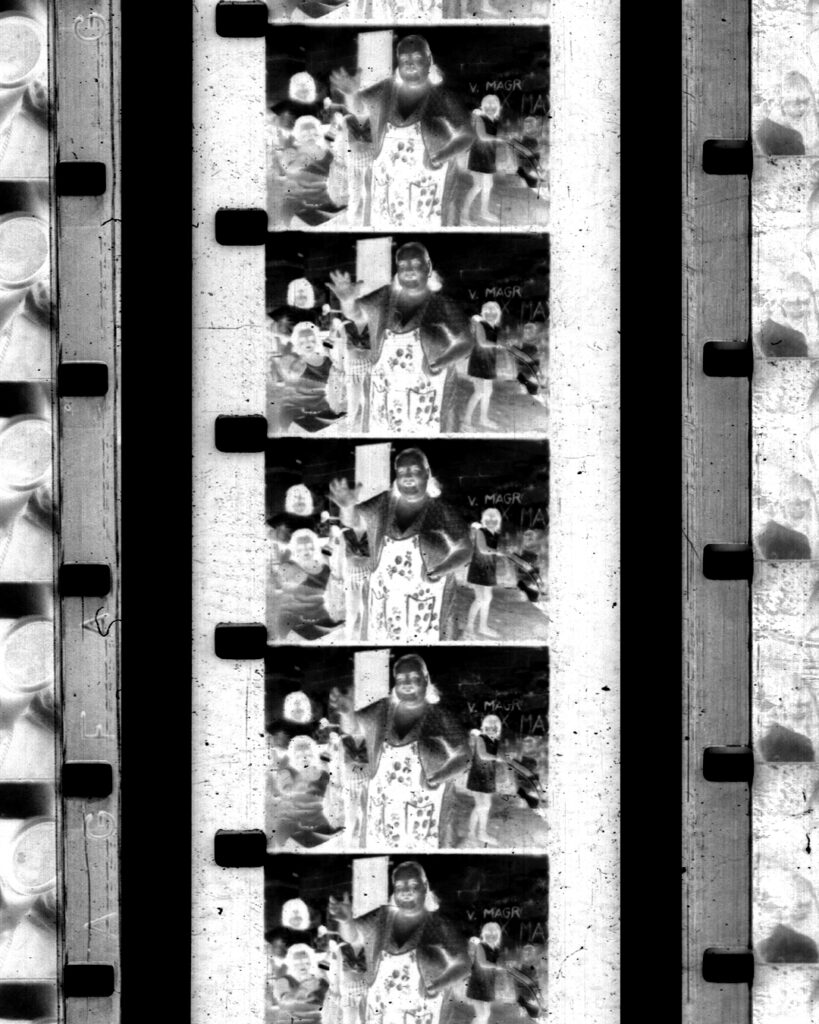
Why show the whole strip of 16mm film when a tighter crop would have been the obvious choice? This short text was originally published on my Instagram account. I wrote it after reading a review of the film “Wherever Street Piece” on Letterboxd.com.
A few quick thoughts about one interesting detail concerning analog film, namely the sprocket holes. These are the holes that run along the edge of the film strip and ensure accurate frame alignment as the film runs through different kinds of machines like cameras and projectors. In the world of motion picture film they usually aren’t visible in the final product, as the part or the strip that contains them is framed out by film projectors. However, by now countless experimental films have shown all the parts of the strip like frame line, optical soundtrack and these holes. Already in 1966 Owen Land made literally a piece titled “Film in Which There Appear Edge Lettering, Sprocket Holes, Dirt Particles, Etc.” (you can see it on Ubuweb). Nowadays most of the movies shot on analog film are scanned digitally at some point and during this phase it’s easy to also include areas outside the traditional frame to the final film.
Throughout the years I have noticed that quite a few people dislike this. One example can be seen in here. It’s a review of my latest film “Wherever Street Piece” from Letterboxd.com . In this particular piece, I have left the 16mm film sprocket hole area visible, and in the final film you can also see tiny slivers of the previous and the next frame, below and above the frameline. The author assumes that the reason for this is a desire to reassure the viewer of the film’s authenticity: the will to underline that the piece has existed at some point in an analog format. It is an understandable assumption, although it’s incorrect.
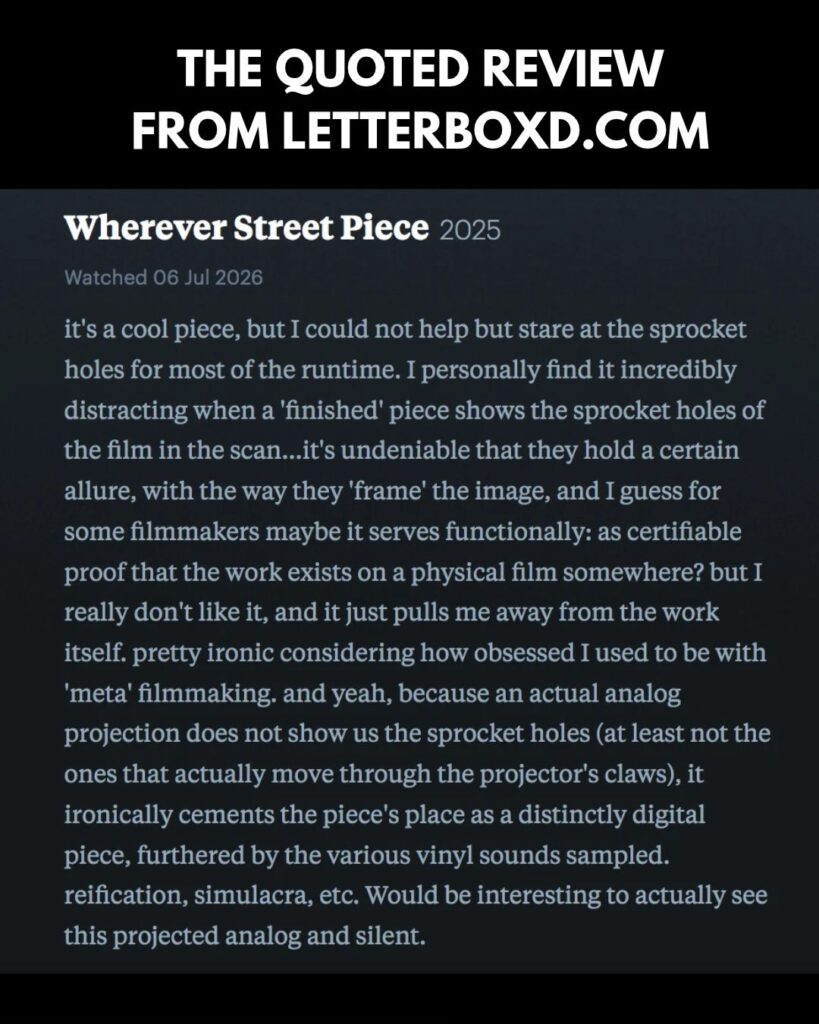
I am not interested in authenticity. At least not in the sense of the oversimplified polarisation analog ➡️ authentic, digital ➡️ fake. As Michael Rush already pointed out in 2007 in his book “Video Art” (2nd edition, pages 188-196), today it’s difficult to determine unambiguously whether a work is, technically speaking, an analogue film or a digital video. A work may be shot on film, but then transferred to a digital format for its final presentation. Some artists, such as Matthew Barney, have even worked the other way around: shooting on video, but transferring the work to film for exhibition.
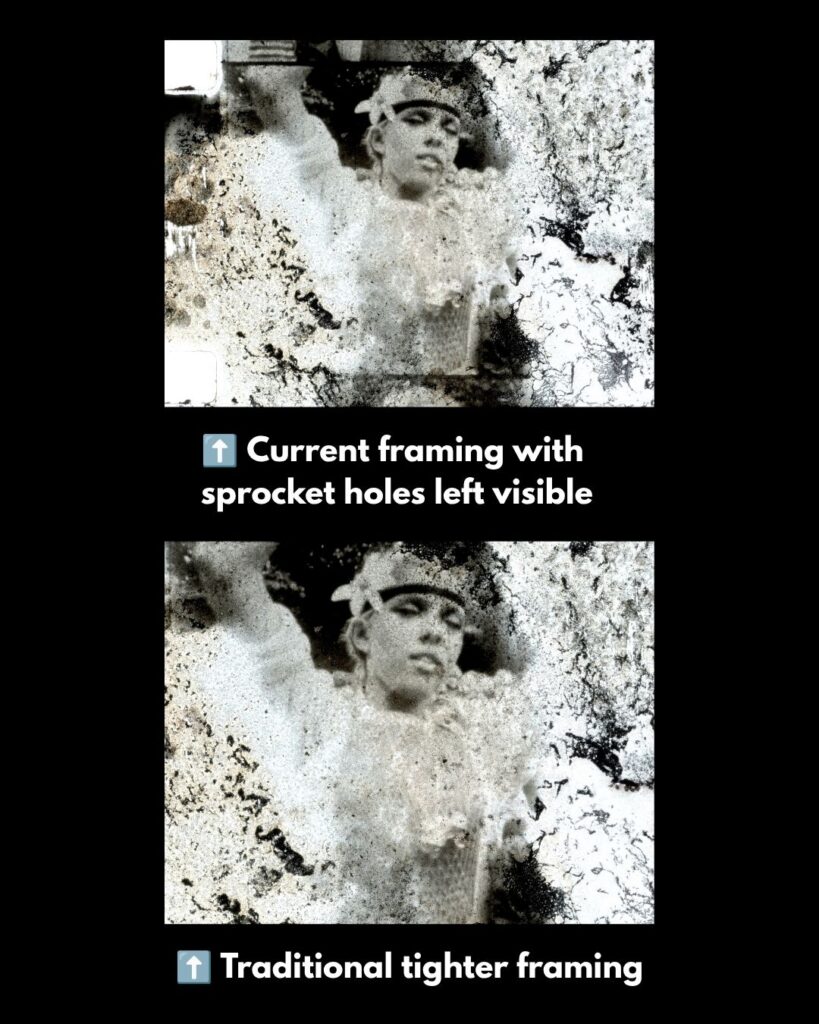
What I am interested in is the visual quality of the image, its texture and the expressive potential of different materials. In the case of “Street Piece”, leaving the full film strip visible produced a far more impressive result than a traditional framing would have. I have manipulated the entire 16mm material seen in the movie with bleach chemicals and naturally the effect isn’t limited inside the traditional frame. Showing the whole strip allows the viewer to see the whole “original canvas” and thus makes the outcome much more compelling compared to the standard framing, where a significant part of the action would have been left out. The side by side comparison above hopefully demonstrates this a bit. In general I don’t have a standard solution on how to frame the image in my movies. Instead, I decide the issue on a case-by-case basis for each work. For example, in my previous movie “Who Has Seen the Wind?” (which was shot on super8) the image was framed in the standard way, because there was no special need to include the other areas outside the traditional frame in the final film.
The author of the review in Letterboxd mentions that they would like to see Street Piece “projected analog and silent.” You almost can. The film is also available as a 16mm screening print, but it’s not silent since the print has optical sound. The image is exactly the same as in the digital version – the overscanned strip has simply been placed inside a traditional film frame.